Unit 6:Thermochemistry.
6.1 Endothermic and Exothermic Processes.
Determine if a process is endothermic or exothermic and assign the
proper sign to ∆H.
-
Is melting ice endothermic or exothermic? Explain your reasoning.
-
A + B → AB ΔH = −50 kJ·molrxn-1 Is the reaction endothermic
or exothermic. Justify how you know.
6.2 Energy Diagrams.
Identify reactants and products as being higher in energy on an energy
diagram.
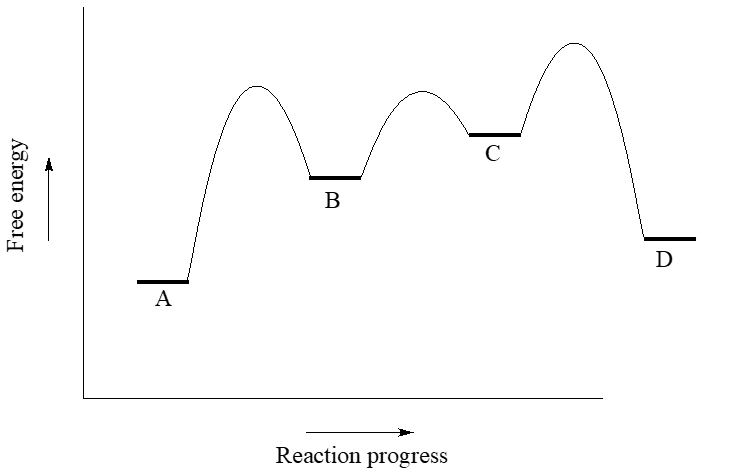
Image credit:
libretexts
-
Does the energy diagram above show a endothermic or exothermic
reaction. Justify your answer.
-
Label the reactants, intermediates, and products on the energy
diagram.
Determine if a process is endothermic or exothermic from an energy
diagram.
-
Given an energy diagram, identify if the reaction absorbs or releases
energy.
-
Explain how the difference in energy between reactants and products
indicates endothermicity or exothermicity.
Calculate ∆H from values on an energy diagram.
-
Using a diagram with energy levels of reactants and products,
calculate ∆H.
-
If reactants are at 150 kJ/mol and products at 80 kJ/mol, what is ∆H?
6.3 Heat Transfer and Thermal Equilibrium.
Interpret a particle diagram using arrows to show heat transfer.
-
Draw arrows to show heat flow when a hot metal rod is placed in cooler
water.
-
Explain the direction of heat transfer between two particle systems at
different temperatures.
Justify energy transfer as resulting from collisions between warmer and
cooler particles.
-
Why does heat flow from a hot object to a cold object at the particle
level?
-
Describe how particle collisions increase the energy of cooler
particles.
Assign the direction of heat flow based on temperature data for two
system components.
-
If a 50°C metal is placed in 20°C water, which way does heat flow?
-
Explain how temperature differences determine the direction of energy
transfer
6.4 Heat Capacity and Calorimetry.
Calculate any variable in q = mc∆T for heating, cooling, and phase
changes.
-
Calculate the heat required to raise the temperature of 100 g of water
by 25°C (c = 4.18 J/g°C).
-
Determine the final temperature if 500 J is added to 50 g of water
starting at 20°C.
Use conservation of energy to calculate temperature changes based on
heat lost/gained by another substance.
-
A 100 g metal at 80°C is placed in 200 g of water at 20°C. What is the
final temperature?
-
Explain how energy lost by one object is equal to energy gained by
another.
6.5 Energy of Phase Changes.
Differentiate between energy changes due to heating/cooling and phase
transitions in a pure substance.
-
How does heating water differ from melting ice in terms of energy
changes?
-
Explain why temperature remains constant during a phase change even
when heat is added.
Calculate the heat of a phase change given temperature, mass, and
enthalpy of phase change data.
-
Calculate the energy required to melt 50 g of ice (∆Hfus = 334 J/g).
- If 2000 J is absorbed, how much ice will melt at 0°C?
6.6 Introduction to Enthalpy of Reaction.
Describe energy exchange between reaction systems and surroundings.
- Explain why an exothermic reaction warms its surroundings.
-
Describe energy flow in an endothermic reaction at the molecular
level.
Calculate the amount of heat absorbed/released in a reaction using ∆H in
a stoichiometric calculation.
-
How much energy is released when 2 moles of H2 react with
O2 to form water (∆H = -286 kJ/mol)?
-
Given ∆H, calculate heat change for a reaction involving 3 moles of
reactant.
Compare and contrast the chemical potential energy of reactants and
products in a system.
-
Which has higher potential energy in an exothermic reaction, reactants
or products?
-
Explain how bond energies affect the chemical potential energy
difference.
6.7 Bond Enthalpies.
Justify the sign of ∆H by comparing bond strengths of reactants and
products.
- How does stronger product bonding than reactants affect ∆H?
-
Explain why breaking bonds requires energy and forming bonds releases
energy.
Calculate ∆H using bond energies and the equation ∆H = ∑[bonds broken] -
∑[bonds formed].
-
Calculate ∆H for H2 + Cl2 → 2 HCl using bond
energies.
-
If bonds broken total 500 kJ and bonds formed total 600 kJ, what is
∆H?
6.8 Enthalpy of Formation.
Calculate ∆H using enthalpies of formation and the equation ∆H°rxn =
∑∆Hf°prod - ∑∆Hf°react.
- Given ∆Hf° of reactants and products, calculate ∆H°rxn.
-
Explain why the sum of formation enthalpies can determine reaction
enthalpy.
6.9 Hess’s Law.
Identify a valid series of steps for an overall process, considering
stoichiometry and energy change.
-
Determine which sequence of reactions correctly represents an overall
reaction.
- Explain how ∆H of steps combines to give overall ∆H.
Manipulate reaction steps to match an overall process and calculate ∆H.
-
Reverse or multiply reactions to match a target equation and calculate
∆H.
-
Show how multiplying a reaction by 2 affects its enthalpy change.
Use Hess’s law results to justify the overall sign of a process, even if
component steps have different signs.
-
Given reactions with mixed ∆H signs, determine overall ∆H using Hess’s
law.
-
Explain why the overall process can be exothermic even if some steps
are endothermic.