Unit 3:Properties of Substances and Mixtures.
3.1 Intermolecular and Interparticle Forces.
List all intermolecular forces present in a pure sample.
- Identify all IMFs present in a pure sample of H₂O
Identify and label the presence of a hydrogen bond.
-
Determine whether hydrogen bonding occurs in ammonia (NH3)
and explain why.
Compare the strength of IMFs present in a sample.
-
Rank London dispersion, dipole-dipole, and hydrogen bonding in order
of strength.
Justify differences in physical properties of two substances based on
IMF strength and atomic/electronic structure.
- Explain why H2O has a higher boiling point than H2S.
Use Lewis structures to determine IMFs and their impact on interactions.
-
Draw the Lewis structure of CH2Cl2 and identify
its intermolecular forces.
3.2 Properties of Solids.
Identify the type of solid given its formula or properties.
-
Classify NaCl as ionic, molecular, metallic, or covalent network
solid.
-
A solid is is not conductive as a solide however creates a conductive
solution when dissolved in water. What type of solid it is?
Use IMFs/interparticle forces to explain variations in physical
properties.
-
Explain why CH₄ is a gas at room temperature while C₆H₁₄ is a liquid.
Justify solid properties using representations of ionic, molecular,
metallic, and network covalent solids.
-
Explain why diamond (covalent network) is hard while NaCl (ionic) is
brittle.
Compare and contrast the properties of different solid types.
-
Compare the electrical conductivity of metallic solids vs. ionic
solids.
3.3 Solids, Liquids, and Gases.
Compare the movement and packing of particles in different phases.
-
Describe how particle arrangement differs between solids, liquids, and
gases.
Draw a representation of a substance in solid, liquid, and gas phases.
-
Sketch H2O molecules in solid, liquid, and gas states.
3.4 Ideal Gas Law.
Analyze graphs of P, V, T, and n to determine relationships.
-
Sketch a graph of Pressure vs. Volume as a sample Argon (Ar) gas is
compressed to a small volume wwith a piston at constant temperature.
Use PV = nRT to calculate gas conditions.
-
Calculate the pressure of 2.0 mol of gas in a 5.0 L container at 300
K.
Determine unknown gas conditions given initial and final states.
-
If a gas at 1.0 atm and 300 K is compressed to half its volume, what
is the new pressure?
Apply mole fraction to determine partial pressure.
-
A mixture contains 2 mol O₂ and 3 mol N₂ at 5 atm. What is the partial
pressure of O₂?
Calculate gas density given identity, temperature, and pressure.
- Calculate the density of CO₂ at 1.00 atm and 298 K.
Convert between moles and volume of a gas at STP using the molar volume
of a gas: 22.4L = 1 mol
-
How many moles are in 224L of Ne(g) at 1 atm and 0oC?
3.5 Kinetic Molecular Theory.
Draw a representation of gases under given conditions.
- Sketch particle spacing for a gas at high vs. low pressure.
-
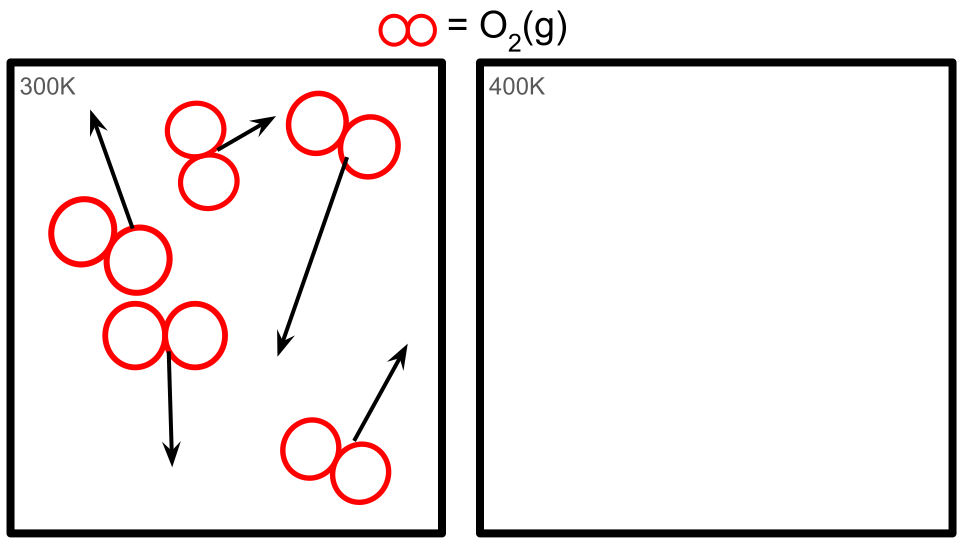
The diagram below shows a particle diagram of a sample of O2(g) at
300K. Sketch the sample after it has been increase to 400K
Use the kinetic energy equation to compare gas velocities.
-
Justify whether the average velocity of Neon (Ne) or Argon (Ar) is
greater at 300K
Interpret Maxwell-Boltzmann distributions to identify unknown gases.
-
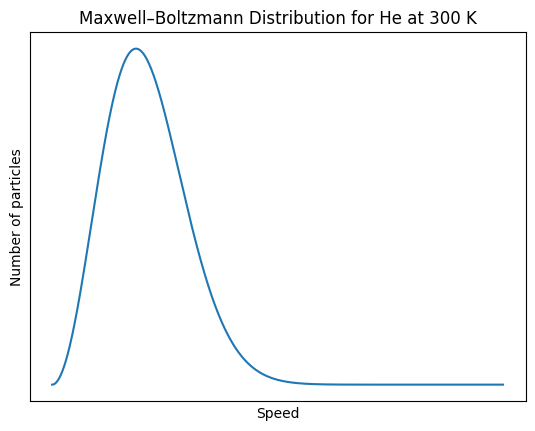
The Maxwell-Boltzmann distribution of He at 300K is shown. Sketch the
Maxwell-Boltzmann distribution of He at 400K.
3.6 Deviation from Ideal Gas Law.
Justify differences between ideal and real gas behavior based on gas
properties, IMFs, and conditions.
-
Explain why real gases deviate from ideal behavior at low temperature.
3.7 Solutions and Mixtures.
Use M = mol/L to calculate concentration, amount, mass, or volume.
-
What is the concentration of a solution containing 0.50 mol NaCl in
250 mL?
Use M₁V₁ = M₂V₂ for dilution calculations.
-
What volume of 2.0 M HCl is needed to make 500 mL of 0.50 M HCl?
3.8 Representations of Solutions.
Represent component interactions and concentrations using particulate
models.
-
Draw a particulate diagram showing Na+ and Cl-
ions in aqueous solution.
Draw solutions with correct proportions to depict concentration.
-
Sketch a solution with twice the concentration of solute compared to
another.
Illustrate solute-solvent interactions.
-
Draw how water molecules interact with Na+ ions in
solution.
3.9 Separation of Solutions and Mixtures.
Choose the appropriate separation technique for a solution/mixture.
-
How could a salt water solution be seperated into salt and water
Calculate Rf values from chromatography data.
-
If a pigment moves 2.5 cm and the solvent front is 5.0 cm, calculate
Rf.
Compare Rf values based on intermolecular interactions.
-
Molecule A is more polar than Molecule B. Which molecule would travel
further for a paper chromatography seperation using water as a
solvent.
3.10 Solubility.
Determine miscibility of two liquids based on IMFs.s
- Explain why water and hexane are immiscible.
Select the best solvent for dissolving a solid solute based on IMFs
- Which solvent would best dissolve NaCl: hexane or water? Why?
3.11 Spectroscopy and the Electromagnetic Spectrum.
Assign the correct electromagnetic spectrum region for molecular
rotation, vibration, and electronic energy transitions.
-
Identify the region of the spectrum used to study molecular vibrations
3.12 Properties of Photons.
Convert between wavelength and frequency using c = λν.
- What is the frequency of light with a wavelength of 500 nm?
Convert between energy and frequency using E = hν.
-
What is the energy of a photon with frequency 6.0 × 10¹⁴
Hz?
Use frequency as a bridge to convert between wavelength and energy.
- Determine the energy of a photon with wavelength 400 nm.
3.13 Beer-Lambert Law.
Select the correct wavelength for maximum absorbance based on absorbance
vs. wavelength graphs.
-
Use the absorption spectrum below to determine the wavelength a
spectrophotometer should be set to determine the concentration of
chlorophyll A.

Use absorbance vs. concentration graphs to find A or c.
-
If ε = 1.2 L/mol·cm and b = 1.0 cm, what is A for a 0.20 M solution?
Recognize that the slope of A vs. c graphs equals εb.
-
Given a slope of 0.80 in an A vs. c graph with b = 1.0 cm, calculate
ε.
Use A = εbc to calculate concentration, given path length and molar
absorptivity.
-
A solution has A = 0.60, ε = 200 L/mol·cm, and b = 1.0 cm. What is its
concentration?