Unit 4: Chemical Reactions.
4.1 Introduction for Reactions.
Use indications of change to distinguish between physical and chemical
changes.
-
List two indicators of a chemical change and apply them to burning
wood.
Differentiate between a physical change or a chemical change.
-
Is melting ice a physical or chemical change? Justify your answer.
Classify common processes as physical or chemical changes.
-
Classify baking a cake, dissolving salt, and cutting paper as physical
or chemical changes.
4.2 Net Ionic Equations.
Represent a physical change (i.e., dissolving) using a net ionic
equation.
- Write the net ionic equation for NaCl(s) dissolving in water.
Write a balanced net ionic equation for a chemical change, considering
both number of atoms and charge.
- Write the net ionic equation for AgNO₃(aq) + NaCl(aq) → ?
4.3 Representations of Reactions.
Represent a physical change with a particle diagram showing a difference
in particle spatial arrangement.
- Draw a particle diagram for H₂O in solid and liquid phases.
Draw a particle diagram for a chemical process with equal numbers of
atoms before and after the change.
-
Draw the reaction vessel after the reaction has gone to completion.
2H2 + O2 → 2H2O
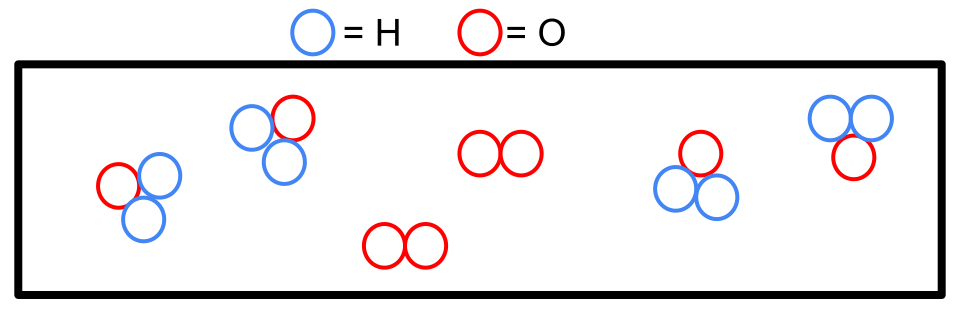
Draw a particle diagram for a chemical change that balances charge.
-
Show NaCl(s) dissolving in water, with Na+ and Cl-
ions represented correctly.
4.4 Physical and Chemical Changes.
Justify a change as either a physical or chemical process based on
bonding changes.
-
Explain why condensation of water is physical but combustion of
hydrogen is chemical.
Compare and contrast physical changes involving only IMFs (such as phase
changes) with those that involve bond breaking (such as dissolving an
ionic solid).
-
Compare melting ice to dissolving NaCl in terms of forces involved.
4.5 Stoichiometry.
Balance a chemical equation.
- Balance the equation: C₃H₈ + O₂ → CO₂ + H₂O.
Clearly denote the mole ratio for a chemical process given a chemical
reaction.
- What is the mole ratio of H₂ to O₂ in 2H₂ + O₂ → 2H₂O?
Apply the Law of Conservation of Mass to determine theoretical yield
given mass amounts.
-
From 25 g of CaCO₃, calculate the mass of CO₂ produced on
decomposition.
Use molarity to perform stoichiometric calculations for reactions with
solutions.
-
What volume of 0.20 M NaOH is required to neutralize 50.0 mL of 0.10 M
HCl?
4.6 Introduction to Titration.
Label a titration setup with terminology: analyte, titrant, indicator,
buret.
-
Label the analyte, titrant, indicator, and buret in a standard
acid–base titration diagram.
Use titration terminology to identify known, unknown, consumed, and
excess species at various titration points.
-
At the equivalence point of an HCl–NaOH titration, what species are
present?
Perform a titration to the endpoint.
-
Why does overshooting the endpoint with NaOH produce inaccurate
results in an acid–base titration?
Use MacidVacid = MbaseVbase
at the equilavence point to calculate the molarity of an unkown acid or
base.
-
If 25.0 mL of HCl requires 30.0 mL of 0.10 M NaOH, calculate the
molarity of HCl.
4.7 Types of Chemical Reactions.
Classify a reaction by identifying the transferring species: protons,
electrons, or ions.
-
Classify Zn + Cu2+ → Zn2+ + Cu as a
proton, electron, or ion transfer reaction.
Determine if a species is oxidized, reduced, or neither by assigning
oxidation numbers.
-
Assign oxidation numbers in 2H2 + O2 →
2H2O and identify what is oxidized/reduced.
Complete a combustion reaction of a hydrocarbon.
-
Write the balanced chemical reaction for the combustion of octane
(C8H18).
Identify the product of a precipitation reaction using the SNAP
mnemonic: sodium (Na+), nitrate (NO3+),
ammonia (NH4+), potassium (K+) ions are
always soluble
-
Predict whether a precipitate forms when
Na2SO4(aq) and BaCl2(aq) are mixed.
4.8 Introduction to Acid-Base Reactions.
Label the Brønsted-Lowry acid, base, conjugate acid, and conjugate base
in a reaction.
-
Label the acid, base, conjugate acid, and conjugate base in HCl + H₂O
→ H₃O⁺ + Cl⁻
Recognize that water is amphoteric and label it as either an acid or a
base given the overall reaction.
-
In NH3 + H2O → NH2+ +
OH-, is water acting as an acid or a base?
List the strong acids and strong bases.
- Name the 6 strong acids and at least 6 strong bases.
Compare the relative strengths of acids and bases based on dominant
species after the reaction.
-
After NH3 reacts with H2O, explain which species
is the stronger base.
Draw a particle diagram of a weak or strong acid and label
Brønsted-Lowry acid/base in reactants and conjugate acid/base in
products.
- Draw a particle diagram for HCl dissociating in water and label acid/base pairs.
4.9 Oxidation-Reduction (Redox) Reactions.
Balance a redox reaction given a table of half-reactions, ensuring
conservation of atoms and electrons.
- Write a complete balanced reaction from the 2 half-reactions.
Fe2+ + 2e- → Fe
Al → Al3+ + 3e-