Unit 2: Compound Structure and Properties
2.1 Types of Chemical Bonds.
Apply Coulomb’s Law and electronic structure to compare
electronegativity values for two elements.
-
Explain why Fluorine (F) is more electronegative than Bromine (Br)
Classify a bond as ionic, non-polar covalent, polar covalent, or
metallic using periodic trends or electronegativity values.
-
Classify each as non-polar covalent, polar covalent, ionic, or
metallic: Mg-O, B-F, Na-Na, O-O?
Assign partial charges to atoms in a bond based on electronegativity.
-
Assign the partial charges to the polar covalent molecule carbon
monoxide (CO)
Recognize that ionic and covalent bonds exist on a continuum, with polar
covalent bonds in between.
-
Given an example of a covalent bond that has greater ionic character
than a N-O bond?
Describe the nature of bonding in terms of electron donation,
acceptance, sharing, or delocalization.
-
Match the descriptors to ionic, covalent, or metallic bonding:
electron sharing, electron donating, delocalized electrons, electron
accepting, non-directional bonding.
2.2 Intramolecular Force and Potential Energy.
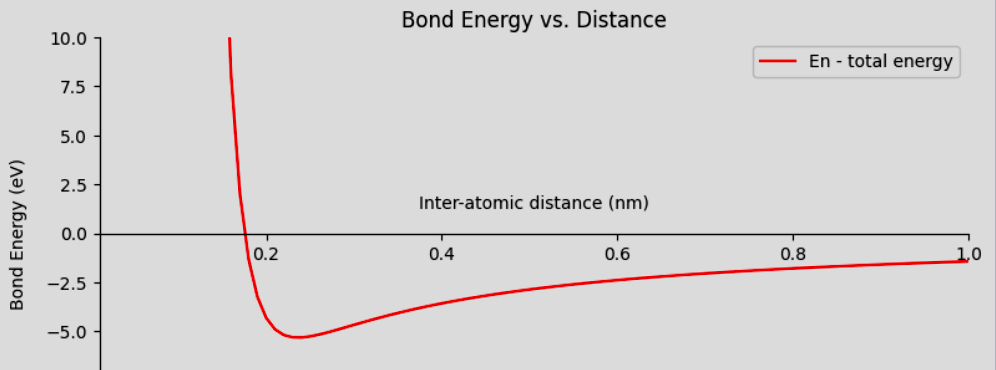
Examine a potential energy vs. distance graph to determine bond length
and bond energy.
-
What is the bond length on bond energy of the bond depicted in the
graph.
Identify the bond order of a bond.
- Determine the bond order for molecules: O₂, N₂, and CO.
Compare the relative strength and length of single, double, and triple
bonds.
-
Use Coulomb’s Law to compare the strength of bonds in molecules such
as HCl, NaCl, and F₂.
Apply Coulomb’s Law to compare the strength of given bonds.
2.3 Structure of Ionic Solids.
Sketch a simple lattice structure for an ionic solid.
-
Sketch the crystal lattice of NaCl, correctly labeling relative sizes
and charges of each ion
2.4 Structure of Metals and Alloys.
Sketch a simple model of a metallic solid.
-
Sketch a particle diagram of a copper (Cu). Be sure to correctly show
charge and location of the positively charged ions and electrons.
Determine if two metals will form an interstitial or substitutional
alloy based on their relative sizes.
-
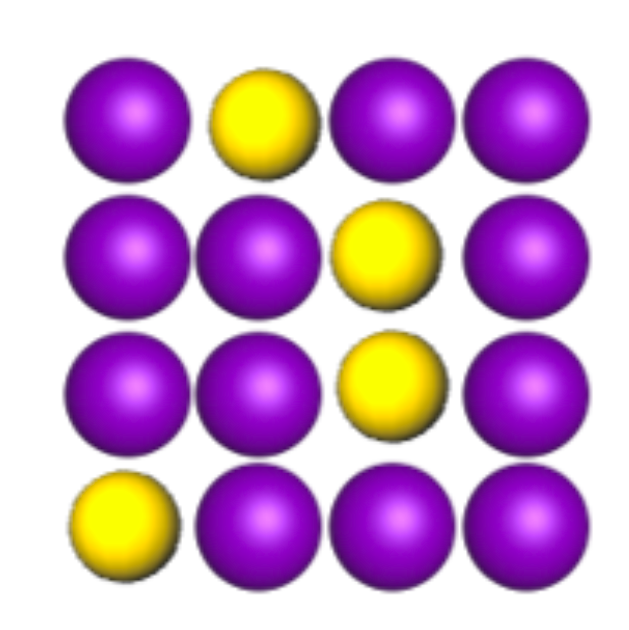
Does the image below represent a substiutional or interstitial alloy.
Justify your answer.
Compare the main properties of interstitial and substitutional alloys.
-
Fill in the blanks for the generalized properties of alloys.
__________ alloys increase the strength, hardness and rigidity of
metals while _____________retain the high malleability and ductility
of metals.
2.5 Lewis Diagrams.
Draw a Lewis structure that obeys the octet rule given a molecular
formula.
- Draw the lewis structure of NH₃
Evaluate a Lewis structure to determine if it is valid.
- Explain why O2 does not contain triple bond
Complete a partial Lewis structure so that it obeys the octet rule.
-
Complete the skeleton structure of diatomic nitrogen (N2),
showing all bonding and non-bonding electrons. N-N
2.6 Resonance and Formal Charge.
Draw a Lewis structure with resonance when multiple valid configurations
exist.
-
Draw the lewis structure of ozone (O3), showing all equally
valid resonance structures.
Complete a partial Lewis structure so that it minimizes formal charges.
-
Place all bonding and non-bonding electrons on the skeleton structure
for N2O. N-N-O
Choose the best Lewis structure from several valid options based on
formal charge.
-
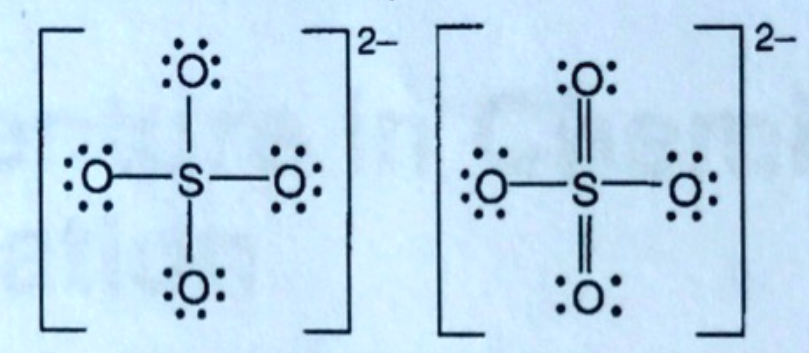
Determine which of the following lewis structures minimizes formal
charge.
2.7 VSEPR and Hybridization.
Identify the VSEPR geometry for a given molecule.
- What is the VSEPR geometry of methane CH4?
Assign bond angles based on hybridization (up to sp³).
-
What are the bond angles of BF3, H2O, and CO2?
Justify the properties of a compound based on its geometry (e.g., presence of a dipole moment).
- Explain if CH4 and H2O are polar base on their VSEPR geometries.
Quantify the number of pi and sigma bonds in a molecule.
- How many sigma and pi bonds are in ethane (C2H6), ethene (C2H4), and Ethyne (C2H2)?
Identify two molecules as geometric isomers.
- Are the molecules below resonance structure, geometric isomers, or neither

Compare the bond strength of sigma and pi bonds.
- Justify whether a sigma or pi bond is stronger.