Unit 1: Atomic Structure and Properties.
1.1 Moles and Molar Mass.
Apply Avogadro’s number to calculate the number of moles given the
number of particles (atoms, molecules, formula units, ions) in a
substance and vice versa.
-
How many moles are in 3.01x10²³ molecules of
CO2?
Use molar mass to convert between mass and moles of a substance.
- How many moles are in 25.0 g of H2O?
Use subscripts to convert between molecules and the number of atoms of a
given element.
- How many hydrogen atoms are in 2 molecules of NH3?
1.2 Mass Spectra of Elements.
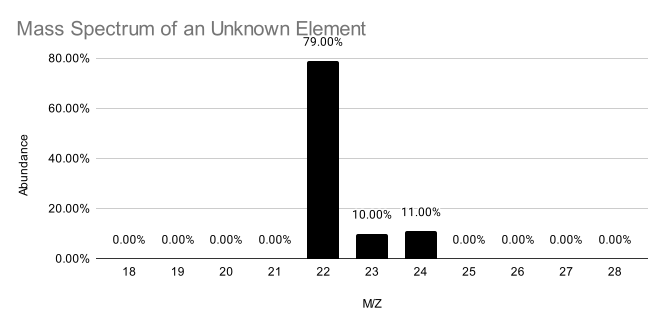
Identify an element given its mass spectrum.
- What element is represented by the mass spectra?
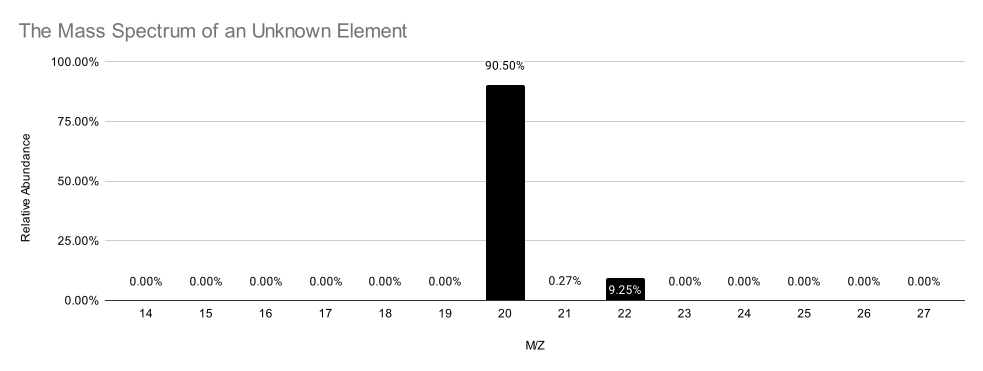
Calculate the average atomic mass of an element given its mass spectrum.
-
What is the average atomic mass of the element depicted in the mass
spectrum below?
1.3 Elemental Composition of Pure Substances.
Determine the empirical formula of a compound given data.
-
What is the empirical formula of a compound contains 40.0% carbon,
6.7% hydrogen, and 53.3% oxygen by mass?
Determine the ratio of atoms in a compound when given mass amounts.
-
A 500.0 g sample of an unknown compound contains the following masses
of each element:
Determine the empirical formula of the unknown compound.
Determine the measurements/steps needed to determine the formula of a
compound in the lab (gravimetric analysis).
-
Magnesium metal (Mg) reacts with oxygen gas (O2) to form
magnesium oxide (MgxOy) when heated. Use the lab
data to determine the empirical formula of magnesium oxide. Mass of
sample before heating : 1.00g, Mass of sample after heating: 1.66g.
1.4 Composition of Mixtures.
Compare and contrast pure substances and mixtures.
-
Classify the following as a pure substance or mixture: (a) salt water
(b) gold (c) air.
Perform calculations to determine the formula and/or purity of a
compound by calculating/comparing relative amounts.
-
A mixture of magnesium oxide (MgO) and sodium oxide (Na2O)
contains the 25.0% Mg, 43.4% Na and 31.6% O. What percent by mass of
the mixture is MgO?
1.5 Atomic Structure and Electron Configuration.
Identify the location of subatomic particles and the charge of areas of
the atom.
-
Summarize the location, charge, and relative mass of the subatomic
particles.
Understand and apply the terms: shell (or energy level), subshell (or
sublevel), and orbital in reference to the quantum mechanical model.
-
Describe the atomic structure of Neon (Ne) using the terms: shell,
subshell, and orbital.
Qualitatively apply Coulomb’s law and effective nuclear charge to
justify differences in attractive force between nucleus and core vs.
valence electrons.
- Why are valence electrons easier to remove than core electrons?
Write the electron configuration for an atom or ion.
- Write the electron configuration for Cl
- Write the electron configuration for O2-.
- Write the electron configuration for Mn2+
Determine the number of unpaired electrons in an atom.
- How many unpaired electrons are in a nitrogen atom?
Differentiate electronic structure in terms of shells and subshells.
-
What is the difference between the 2s and 2p subshells in terms of
energy and shape?
Qualitatively apply Coulomb’s law to discuss differences in ionization
energy by comparing electron shells/subshells between atoms.
-
Why does lithium (Li) have a higher ionization energy than potassium
(K)?
-
Why does lithium (Li) have a lower ionization energy than nitrogen
(N)?
1.6 Photoelectron Spectroscopy.
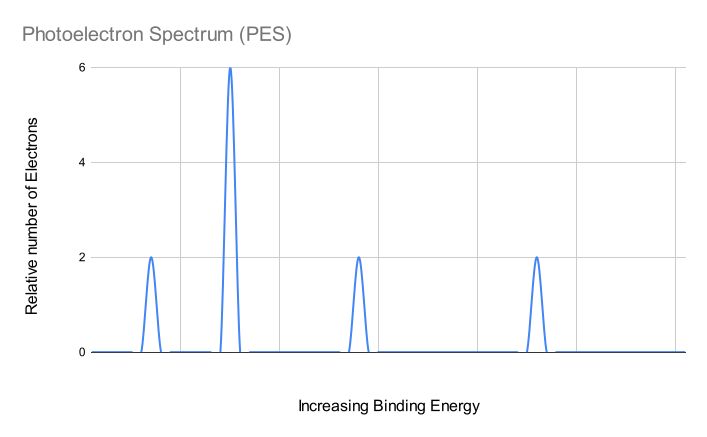
Identify an element based on its PES (Photoelectron Spectroscopy).
- Identify the element shown in the PES below
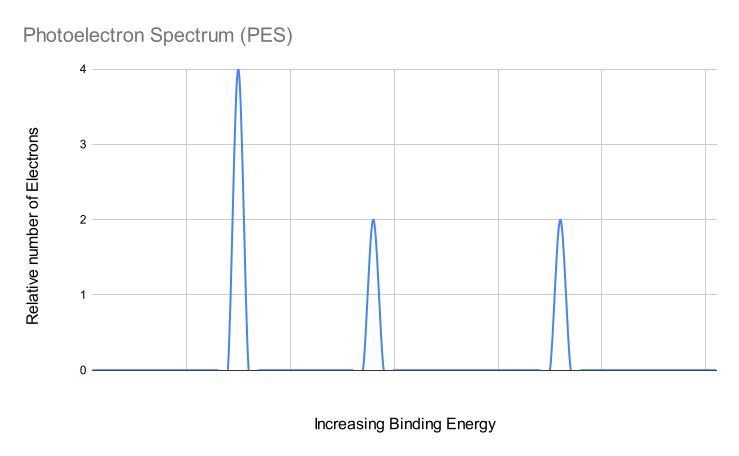
Label the peaks on a PES spectrum with the corresponding subshell.
-
In a PES spectrum of oxygen below , label which peaks correspond to
1s, 2s, and 2p electrons. PES of a unkown element 2p,2s,1s
Compare heights of peaks in the spectrum to determine the number of
electrons in a subshell.
-
If the 2p peak is three times the height of the 2s peak in a PES
spectrum, how many electrons are in each subshell?
Explain differences between PES spectra of two atoms/ions.
-
How would the PES spectrum of Na differ from that of Na+?
1.7 Periodic Trends.
Apply Coulomb’s Law and atomic structure features to compare atomic
properties between two elements.
- Explain why fluorine has a smaller atomic radius than oxygen.
Use periodicity to predict or estimate values of properties of elements.
- Which element has a higher first ionization energy: Na or K?
1.8 Valence Electrons and Ionic Compounds.
Predict the type of bond that will form between two atoms based on their
valence electrons.
-
What type of bond is expected between magnesium (Mg) and chlorine
(Cl)?
-
What type of bond is expected between carbon (C) and chlorine (Cl)?
Choose a compound with similar properties to a given compound based on
periodicity.
-
Which compound has properties most similar to NaCl: KCl,
CaCl2, or ClF?
Predict the charge on an atom by its location on the periodic table.
- What charge does a calcium atom form when it becomes an ion?