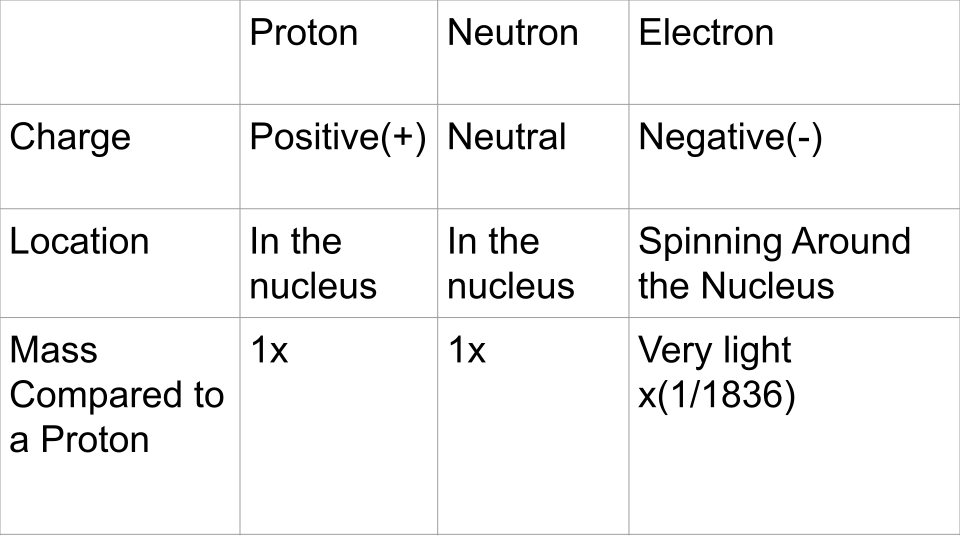
Identify the location, the charge, and the approximate relative mass of the subatomic particles of the atom.
-
Summarize the location, charge, and relative mass of the subatomic particles.
Understand and apply the terms: shell (or energy level), subshell (or sublevel), and orbital in reference to the quantum mechanical model.
- Describe the atomic structure of Neon (Ne) using the terms: shell, subshell, and orbital.
Neon (Ne) has 2 shells. The first shell has 1 subshell with 1 orbital (1s). The second shell has 2 subshells (2s,2p). The 2s subshell has one spherical orbital. The 2p subshell has 3 dumbbell shaped orbitals. Each orbital contains 2 electrons.
Qualitatively apply Coulomb’s law and effective nuclear charge to justify differences in attractive force between nucleus and core vs. valence electrons.
- Why are valence electrons easier to remove than core electrons?

Write the electron configuration for an atom or ion.
- Write the electron configuration for Cl
![[Ne]3s23p2](images/image1.5.1.svg)
- Write the electron configuration for O2-.

- Write the electron configuration for Mn2+.

Determine the number of unpaired electrons in an atom.
- How many unpaired electrons are in a nitrogen atom?

Differentiate electronic structure in terms of shells and subshells.
-
What is the difference between the 2s and 2p subshells in terms of
energy and shape?
Within a shell,the s subshells are lower energy than p subshells. The orbital in a s subshell is sphere shaped. The orbticals in a p subshell are "3D dumbbell" shaped.
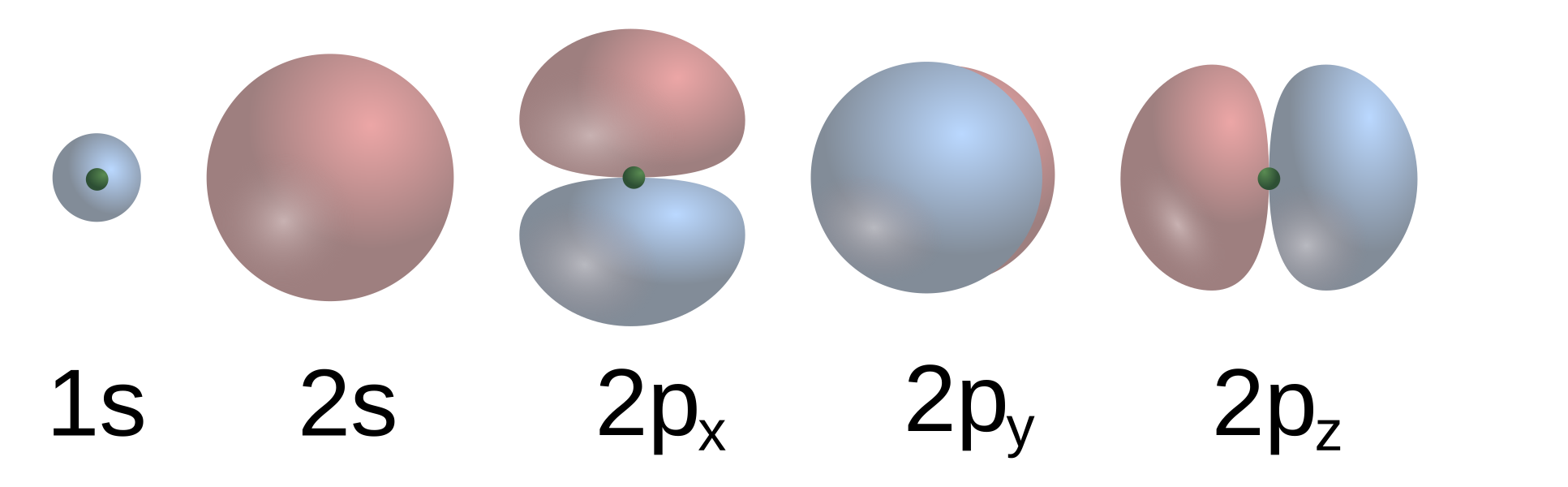 This file was made by User:Sven., CC BY-SA 3.0, via Wikimedia Commons>
Use Coulomb’s law to discuss differences in ionization energy by comparing electron shells/subshells between atoms.
- Why does lithium (Li) have a higher ionization energy than potassium (K)?
Lithium's (Li) valence electron is in the 2nd shell, while potassium's (K) is in the 4th shell. Therefore Li's valence electron is closer to the nucleus and has a greater Coulombic attractive force, resulting in a greater ionization energy.
- Why does lithium (Li) have a lower ionization energy than nitrogen (N)?
Li's nucleus has 3 protons while N's has 7 protons. N's valence electrons experience a greater Coulombic attractive force from N's nucleus resulting in a higher ionization energy. - Why does lithium (Li) have a lower ionization energy than nitrogen (N)?
-
What is the difference between the 2s and 2p subshells in terms of
energy and shape?
- Write the electron configuration for O2-.
- Write the electron configuration for Cl
- Describe the atomic structure of Neon (Ne) using the terms: shell, subshell, and orbital.
